
Criminal Court Records in Snyder County
A criminal court record in Snyder County is the case-level file kept for the criminal division of the Court of Common Pleas and related Magisterial District Court activity. The Clerk of Courts function within Stephanie Wolf's Prothonotary, Clerk of Courts, and Clerk of Orphans' Court office maintains Common Pleas criminal filings at 9 West Market Street, Middleburg, Pennsylvania 17842. The office phone is 570-837-4202, and the published email is prothonotary@snydercounty.org. Criminal records may include the complaint or information, docket entries, arraignment records, an entry of appearance, waiver of arraignment, motions, guilty plea colloquy, continuances, trial or plea results, sentencing orders, costs, restitution, and post-sentence filings.
Snyder County is part of Pennsylvania's 17th Judicial District with Union County. The Court of Common Pleas is the county-level trial court of general jurisdiction and handles misdemeanor and felony criminal matters once they are held for court or otherwise filed there. The county also has two Magisterial District Courts: District 17-3-03 in Selinsgrove, with Scott Zeigler, and District 17-3-04 in Middleburg, with Bo Trawitz. Those MDJ courts process criminal complaints, private criminal complaints, preliminary arraignments, preliminary hearings, summary matters, and search warrants. A reader who only needs the charge path can use arrest records and court charge records, while custody status belongs with inmate records and outstanding bench or arrest orders belong with warrant records.
The Snyder County District Attorney page identifies the local prosecutor and explains the office's role in adult and juvenile prosecutions.
That prosecution role matters because the court record may show charges that police initiated, charges the District Attorney pursued, and later dispositions entered by the court.
How to Search Snyder County Criminal Court Records
The main public online channel is Pennsylvania UJS Case Search. The UJS public docket service covers Pennsylvania appellate courts, criminal Courts of Common Pleas, Magisterial District Courts, and Philadelphia Municipal Court cases. For Snyder County, that means Common Pleas criminal docket sheets and MDJ criminal or summary docket sheets are the central online record source. Public docket sheets are free, but secure docket sheets and restricted services require approved login access.
- Open UJS Case Search and choose a search type. Use docket number when known, participant name for a defendant search, OTN for a criminal tracking number, citation number for summary or traffic-related criminal matters, or complaint number when that is the only identifier available.
- Select Snyder County when the case was filed locally. If the portal offers judicial district filtering, Snyder County is in Judicial District 17, Snyder/Union.
- For MDJ matters, narrow by the court office if known. District 17-3-03 is located at 1025 US Rt. 522, Selinsgrove, and District 17-3-04 is at 32 East Market Street, Middleburg.
- Open the docket sheet and review the case caption, filing or complaint date, court office, charge list, docket entries, scheduled events, disposition, financial obligations, and any cross-court docket number.
- Contact the Snyder County Clerk of Courts for certified copies, full file access, older documents, or items not displayed online. Mail filings and copy requests should be directed to the courthouse office, and the county states that fax and email filings are not accepted for filing of record.
UJS warns that recent entries may not appear immediately and that docket sheets should not be used as a substitute for a Pennsylvania State Police criminal history check. The UJS public record is still useful for case research, but it is a court docket, not a statewide background report. Pennsylvania court records are also governed by the UJS Case Records Public Access Policy, so sealed, limited-access, juvenile, and confidential details may be withheld even when a docket exists.
Stages of a Criminal Case
A Snyder County criminal case often begins in Magisterial District Court. Police or an approved complainant initiate charges, the MDJ handles preliminary arraignment and bail, and a preliminary hearing tests whether charges should move forward. At the conclusion of the preliminary hearing, charges may be dismissed, waived to court, or held for court. Charges held for court move to the Court of Common Pleas, where the formal case file is maintained by the Clerk of Courts.
Case flow: Complaint or Arrest › Preliminary Arraignment › Preliminary Hearing › Held for Court or Dismissed › Formal Filing in Common Pleas › Arraignment › Motions › Plea or Trial › Disposition › Sentencing › Post-Sentence Activity
| Stage | What Happens |
|---|---|
| Preliminary arraignment | The MDJ advises the defendant of the charges, sets bail or release conditions, and creates early docket entries tied to the complaint, OTN, and court office. |
| Preliminary hearing | The MDJ decides whether the Commonwealth has enough evidence to hold charges for Common Pleas, dismiss them, or accept a waiver. |
| Common Pleas arraignment | The Court of Common Pleas receives the case, the defendant responds through counsel or pro se filings, and the Clerk of Courts records entries such as appearance forms and waivers. |
| Pretrial and motions | Motions, continuances, suppression issues, discovery disputes, plea negotiations, and treatment-court screening may appear as docket entries. |
| Plea or trial | The docket may show a guilty plea, not guilty verdict, acquittal, jury waiver, nolle prosequi, or other charge-specific outcome. |
| Sentencing | The court enters sentence terms, probation, fines, costs, restitution, payment obligations, treatment conditions, and related supervision orders. |
The Snyder County Probation page explains the office that monitors court-ordered supervision, restitution, costs, treatment court, work release, and community service after sentencing.
Probation information helps explain why a criminal docket may continue to show payment, violation, treatment, or compliance entries after the sentencing date.
What a Snyder County Criminal Court Record Shows
Public criminal docket sheets usually show structured fields and docket text, not every scanned document in the file. A full Snyder County criminal court record can include identifiers from both MDJ and Common Pleas levels, including MJ and CP docket numbers, an OTN, complaint number, incident number, citation number, SID, or cross-court docket number. Certified copies, exemplified copies, and complete file inspection remain office functions through the Clerk of Courts.
| Field | What It Shows |
|---|---|
| Case number | The court's docket identifier, including Common Pleas CP numbers or Magisterial District MJ numbers when the case began at the MDJ level. |
| OTN or complaint number | Criminal tracking identifiers that help connect arrest, complaint, MDJ, and Common Pleas records for the same incident. |
| Defendant and parties | The accused person, Commonwealth, private complainant when applicable, attorneys, and public party details allowed under access rules. |
| Charges | Statute section, offense description, grading, count number, and charge-specific status, which can change as the case proceeds. |
| Docket entries | Chronological filings and court actions such as arraignment, appearance, motions, hearings, continuances, pleas, orders, sentencing, payments, and warrants. |
| Plea and disposition | Whether each count ended in a guilty plea, verdict, dismissal, acquittal, withdrawal, nolle prosequi, or other court-entered outcome. |
| Sentence and financials | Probation, incarceration, fines, costs, restitution, payment plans, PAePay eligibility, and supervision conditions when public. |
| Restrictions | Signals that a record, document, juvenile matter, protected identifier, or limited-access case is not available to ordinary public users. |
Charges vs. Convictions
A charge is an allegation. A conviction is a final guilty outcome by plea or verdict. Snyder County criminal court records can show charges that were dismissed at a preliminary hearing, withdrawn by the prosecutor, reduced in plea negotiations, amended into a different offense, or resolved by acquittal. The distinction is important when reading a docket because a person may have multiple charges listed, but only some may produce a conviction or sentence.
| Charge | Conviction | |
|---|---|---|
| Stage | Accusation filed in MDJ or Common Pleas records | Final guilty plea or guilty verdict entered by the court |
| Proof level | Probable cause or prosecution allegation, depending on stage | Beyond reasonable doubt, or an accepted guilty plea |
| Record meaning | Shows what was alleged and tracked by count | Shows the offense that resulted in judgment and sentence |
Reading Dispositions and Sentences
Disposition language should be read count by count. A case may show one count guilty, one count dismissed, and another count withdrawn or nolle prossed. "Nolle prosequi" means the prosecutor chose not to pursue that charge. A dismissed charge is not the same as a conviction, and an acquittal means the defendant was found not guilty. Sentencing entries may list probation, incarceration, fines, costs, restitution, payment plans, and supervision terms. Snyder County's guilty plea colloquy form also reflects charge, grade, plea agreement, rights acknowledgments, mandatory sentencing questions, attorney certification, and certificate of compliance fields.
Sealed vs. Expunged Records
Pennsylvania uses several access concepts that are easy to confuse. A sealed record is closed from ordinary public inspection by law or court order. Limited access under 18 Pa.C.S. Section 9122.1 shields eligible criminal records from public view while preserving access for courts and criminal justice agencies. Expungement under 18 Pa.C.S. Section 9122 removes eligible criminal history record information from public access and agency dissemination in defined circumstances. Section 9122.5 addresses the effect of expunged records and limited-access records.
| Sealed or Limited Access | Expunged | |
|---|---|---|
| Visibility | Hidden from ordinary public users, although courts and criminal justice agencies may retain access depending on the order and statute. | Removed from public access and treated under the expungement order or statute. |
| Typical source | Court order, Clean Slate limited access, juvenile confidentiality, or other statutory restriction. | Petition, statutory eligibility, court order, or qualifying automatic process. |
| Public search effect | The case or details may not appear in public UJS results. | Eligible information should no longer be publicly disseminated after processing. |
Public Access to Criminal Court Records
Public access to Snyder County criminal court records starts with the judiciary's access rules, not the county Right-to-Know process. Pennsylvania's Right-to-Know Law applies to many county administrative records, but court case records follow judiciary policies and court rules. For court dockets, use UJS Case Search and the Clerk of Courts. For sheriff-held enforcement records, use the Sheriff's Right-to-Know process. For county administrative records, the Commissioners page names Chief Clerk Tony Phillips as Snyder County Right-to-Know Officer, but that channel should not be treated as a shortcut around court case-record limits.
Key Statutes:
UJS Case Records Public Access Policy - Pennsylvania court records are public unless sealed, restricted, confidential, or redacted by policy, rule, statute, or order.
18 Pa.C.S. Section 9122 - Sets out when criminal history record information may be expunged.
18 Pa.C.S. Section 9122.1 - Provides limited-access relief for eligible criminal records.
The Pennsylvania statute page for 18 Pa.C.S. Section 9122 is a source for expungement eligibility language.
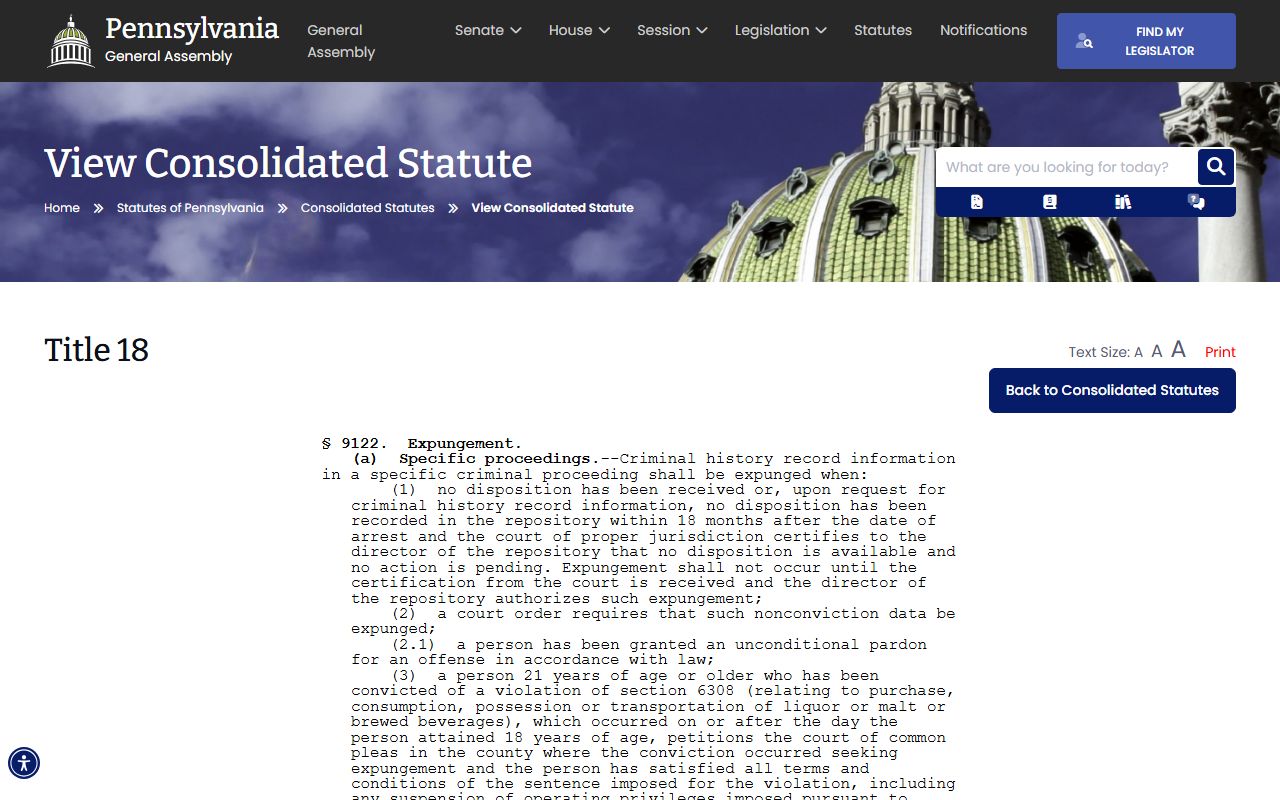
That source supports the practical point that a dismissed or older charge is not automatically gone from public view unless a statute, Clean Slate process, or court order applies.
The separate Pennsylvania statute page for 18 Pa.C.S. Section 9122.1 explains limited-access relief.
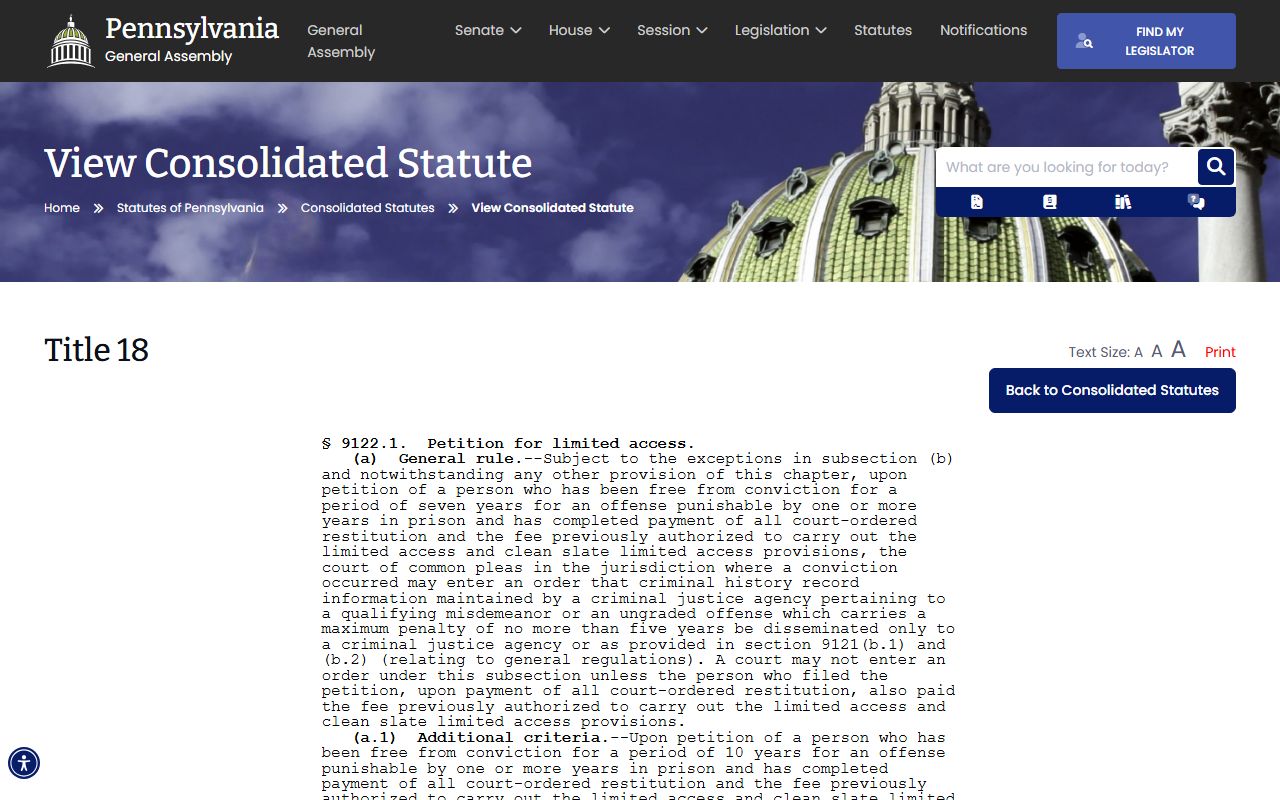
Limited access is different from expungement because the public view may be shielded while criminal justice and court access can remain available.
Background Check Considerations
A court docket is not the same as an official criminal-history background check. UJS specifically warns that docket-sheet information should not replace a Pennsylvania State Police criminal history check. Dockets can be incomplete for background-screening purposes, may include non-conviction charges, and may omit restricted information. Employers, landlords, insurers, lenders, and others with FCRA-regulated purposes should use compliant screening processes rather than casual court lookup.
Important: This website is not a consumer reporting agency and cannot be used for FCRA-regulated screening decisions.
Restricted Criminal Court Records in Snyder County
Juvenile delinquency and dependency files are not ordinary public criminal records. 42 Pa.C.S. Section 6307 limits who may inspect juvenile court files, and public access depends on statutory categories or court orders. Adoption, mental-health, guardianship, and protected family information are also restricted in Pennsylvania. Snyder County filing rules require confidential information to be filed separately under the UJS Public Access Policy, including Social Security numbers, financial account numbers, driver's license numbers, minor names in some contexts, abuse-victim contact information, and similar identifiers. Non-compliant filings can be returned without filing.
When a public search does not show a case, the reason may be delay, retention rules, incorrect search terms, a different court level, limited access, expungement, juvenile confidentiality, or another legal restriction. The practical fallback is to confirm the docket number, OTN, defendant name, county, MDJ office, and Common Pleas case number, then contact the Clerk of Courts for what can be released.