
Snyder County Arrest Records and Court Charges
Arrest records in Snyder County may be held by the law-enforcement agency involved in the arrest, by the Sheriff's Office for county booking or warrant functions, or by the correctional facility when the person was lodged there. Court charges are different. They are the formal allegations tracked by the Magisterial District Court or Court of Common Pleas after a criminal complaint, information, citation, or related charging paper is filed. The Snyder County Sheriff is John A. Zechman, with office contact at 9 West Market Street, Middleburg, Pennsylvania 17842, phone 570-837-3311. The local correctional facility is Snyder County Correctional Facility, 600 Old Colony Road, Selinsgrove, phone 570-374-7912.
The prosecution decision belongs to the District Attorney. Heath Brosius is the Snyder County District Attorney, and the DA page says the office prosecutes adult and juvenile cases, assists crime victims, gives legal guidance to police, and connects users to UJS Common Pleas and MDJ case information. That means court charges after arrest should be verified through court dockets and court filings rather than through jail status alone. A current custody question belongs on inmate records, the complete court case and sentence belong on criminal court records, and broader civil, probate, family, and criminal access belongs on court records.
The Snyder County District Attorney Victim Services page shows the victim notification and case-status support attached to criminal prosecutions.
Victim services are relevant to charge records because victims may receive case-status, disposition, restitution, and sentencing notifications as charges move through court.
How to Find Snyder County Arrest Records and Charges
For public court charge information, start with Pennsylvania UJS Case Search. UJS docket sheets cover criminal Courts of Common Pleas and Magisterial District Courts, which is the key path in Snyder County because many criminal matters begin before an MDJ and move to Common Pleas after a preliminary hearing or waiver. Search by participant name, docket number, OTN, complaint number, citation number, incident number, or SID when available. Select Snyder County or Judicial District 17, Snyder/Union, when the portal offers those filters.
- Use the person's name or known identifier in UJS Case Search. If there is an OTN or complaint number from paperwork, use it because names can vary.
- Check Magisterial District Court results first for recent arrests, summary offenses, preliminary arraignments, preliminary hearings, and charges that have not yet reached Common Pleas.
- Open the docket and read the charge list. Look for statute section, offense description, grading, count number, filing date, and charge-specific status.
- Follow any cross-court docket number into the Court of Common Pleas if charges were held for court, waived to court, or otherwise transferred.
- For certified copies, complete filings, older records, or documents not displayed online, contact the Snyder County Clerk of Courts at 570-837-4202 or prothonotary@snydercounty.org.
No official Snyder County public jail roster was located in the county sources reviewed. The county publishes Correctional Facility contact information and JailATM services, but not a public booking database. For current county custody, call the facility at 570-374-7912. For state-sentenced inmates and parolees, use the Pennsylvania DOC locator. For a sheriff-held record request, the Sheriff's Right-to-Know process and criminal record check form may apply, but those channels do not replace the court docket for charge outcomes.
How Charges Get Filed After an Arrest: Complaint, Information, and Indictment
After an arrest, the first court-facing charge record in Snyder County often appears as a criminal complaint in Magisterial District Court. The MDJ handles preliminary arraignment and preliminary hearing. If charges are held for court or waived, the case moves to the Court of Common Pleas. In Pennsylvania county practice, the formal Common Pleas prosecution commonly proceeds by information filed by the prosecutor, while grand jury indictment is not the routine path for ordinary county cases. The charging document matters because it identifies the alleged offense, count, statute, grade, and defendant.
| Complaint | Information | Indictment | |
|---|---|---|---|
| Filed by | Police, approved complainant, or prosecutor depending on case posture | District Attorney after the case is in Common Pleas | Grand jury, less common in routine Snyder County cases |
| Common for | Initial MDJ criminal, summary, citation, or preliminary-stage charges | Common Pleas prosecution after charges are held or waived to court | Serious or special prosecution settings when authorized |
| What it starts | The court charge path and early docket record | The formal trial-court prosecution | A formal prosecution based on grand jury action |
| Fields to compare | OTN, complaint date, incident number, offense, grade, MDJ office | CP docket, count, statute, grade, plea, disposition | Count, offense, grand jury return, court docket |
The Snyder County Public Defender page explains how eligible defendants request counsel for criminal proceedings.
Public Defender deadlines matter because representation issues can affect arraignment, preliminary hearing, plea negotiation, and charge-disposition entries.
Charge Status and What It Means
Charge status can change several times between arrest and final disposition. A single arrest may generate multiple counts, and each count may have a different status. Some charges are amended to different grades, some are reduced through plea negotiations, some are dismissed at or after preliminary hearing, and some are nolle prossed when the District Attorney does not pursue them. Always read the status beside each charge rather than assuming the first charge listed is the final result.
| Status | What It Means |
|---|---|
| Pending | The charge has been filed and has not reached a final charge-specific outcome. |
| Held for court | An MDJ-level charge has enough preliminary support to proceed to the Court of Common Pleas. |
| Amended or reduced | The charge description, grade, statute, or count has changed, often because of prosecution review, motion practice, or plea negotiation. |
| Dismissed | The court has ended that charge without a conviction, often at a preliminary hearing or by later order. |
| Nolle prosequi | The prosecutor has chosen not to continue with that charge. |
| Guilty plea or verdict | The charge resulted in a conviction and should be read with the sentence and financial sections. |
Charges vs. Convictions
Being arrested or charged is not the same as being convicted. Arrest records may show law-enforcement action or booking, while court charge records show allegations filed in court. A conviction exists only when the court accepts a guilty plea or enters a guilty verdict. The difference matters for employment screening, housing screening, licensing, and personal record review because non-conviction charges can still appear in a public docket unless they are restricted, expunged, or subject to limited access.
| Charge | Conviction | |
|---|---|---|
| Stage | Allegation after arrest, citation, complaint, or prosecutor filing | Final guilty plea or guilty verdict entered by the court |
| Burden of proof | Probable cause or prosecution allegation, depending on hearing stage | Beyond reasonable doubt, or an accepted guilty plea |
| Record impact | Can remain visible on public dockets even without a conviction | Connects to sentence, costs, restitution, probation, and possible collateral consequences |
Sealed vs. Expunged Records
Pennsylvania law distinguishes public dockets, restricted records, limited-access records, and expunged records. Limited access under 18 Pa.C.S. Section 9122.1 shields eligible criminal records from public view without eliminating court and criminal justice access. Expungement under 18 Pa.C.S. Section 9122 removes eligible criminal history record information in defined circumstances. Section 9122.5 addresses the effects of both expunged and limited-access records. Juvenile court-file access is separately restricted by 42 Pa.C.S. Section 6307.
| Sealed or Limited Access | Expunged | |
|---|---|---|
| Visibility | Not available to ordinary public users through normal search. | Removed from public access according to the order or statute. |
| Agency access | Courts and criminal justice agencies may still have access in allowed settings. | Access is controlled by the expungement statute and order. |
| Common trigger | Clean Slate limited access, court order, juvenile confidentiality, or statutory restriction. | Eligibility under Pennsylvania expungement law or a granted petition. |
The Pennsylvania statute page for 18 Pa.C.S. Chapter 91 covers criminal history record information, dissemination, and accuracy concepts.
That criminal-history framework is why an arrest, a charge, and a court disposition should be read as connected but separate record events.
Charge Codes and Severity Levels
Charge records should be read by statute section, offense title, grade, and count. Pennsylvania criminal records may use felony, misdemeanor, summary, and traffic-related grades, depending on the offense. Snyder County MDJs adjudicate traffic and non-traffic citations and handle preliminary criminal matters, while misdemeanor and felony prosecutions can move to the Court of Common Pleas. One arrest can produce several separate charges, such as a primary offense, related possession offense, driving offense, or contempt/warrant issue. The docket may also show whether a charge was reduced, dismissed, or merged for sentencing.
Important identifiers include OTN, complaint number, incident number, citation number, SID, MDJ docket number, and Common Pleas docket number. A reader comparing arrest records with court charges should match these identifiers before assuming that two records describe the same event.
Statewide Charge and Criminal History Lookups
Pennsylvania UJS Case Search is the public court docket source for charge and disposition review, while Pennsylvania State Police criminal history processes are the official route for statewide criminal-history checks. The research also identifies a Snyder County Sheriff's criminal record check request form with a regular $8 fee and a $13 notarized fee, with processing that may take three weeks or longer. That local sheriff form is different from a court docket and different from a statewide PSP background check. Use the court docket to read charge status, and use the appropriate criminal-history channel when the question is a formal background record.
The 42 Pa.C.S. Section 6307 juvenile court-file access page is the source for Pennsylvania juvenile file restrictions.
Juvenile restrictions are important because an arrest or allegation involving a minor should not be treated like an ordinary adult public charge record.
Background Check Considerations
Casual charge lookup and FCRA-regulated background screening are different tasks. A public docket can show pending charges, dismissed charges, amended counts, withdrawn counts, and convictions in the same case, and UJS warns that docket sheets should not replace a Pennsylvania State Police criminal history check. Employers, landlords, insurers, lenders, and other regulated users should not make screening decisions from informal searches. They need compliant consumer-reporting processes, notice rules, dispute rights, and current source verification.
Important: This website is not a consumer reporting agency and cannot be used for FCRA-regulated screening decisions.
The statute page for 18 Pa.C.S. Section 9122.5 explains effects of expunged and limited-access records.
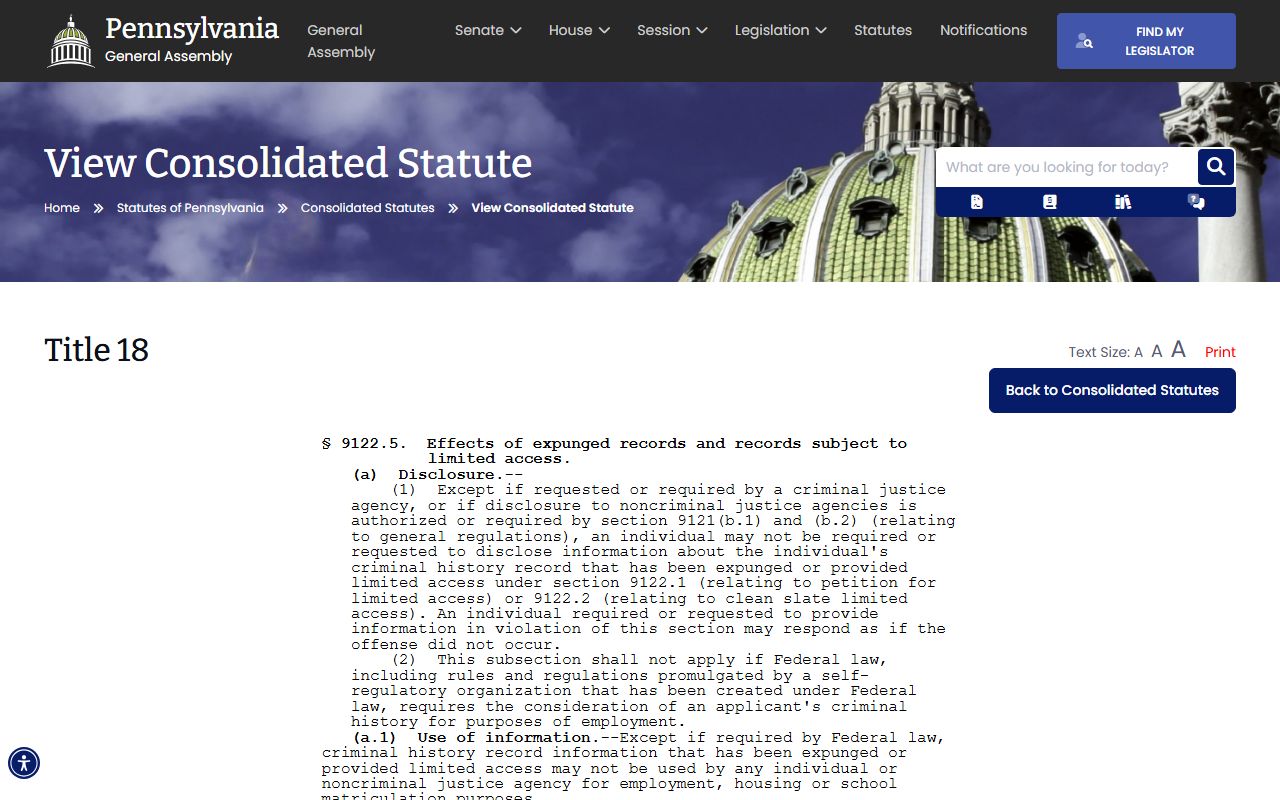
That source reinforces why record status must be checked at the official court or criminal-history source before relying on old arrest or charge information.
Restricted Charge Records in Snyder County
Restricted charge records include juvenile matters, sealed cases, limited-access cases, expunged records, adoption-related criminalized conduct when tied to restricted Orphans' Court matters, mental-health information, and filings that contain protected identifiers. Snyder County filing rules require confidential information to be filed separately under the UJS Public Access Policy. Examples include Social Security numbers, financial account numbers, driver's license numbers, minor names in some contexts, abuse-victim contact information, and other protected identifiers. The public may see a docket-level event while the underlying document remains unavailable.
For charge questions tied to active warrants, use the Snyder County Sheriff's warrant page or the public CountySuite warrant portal, then verify the related court docket. For custody questions, call the correctional facility because no official public Snyder County jail roster was confirmed. For final charge outcomes, use UJS and the Clerk of Courts. For victim notification and case-status help, the DA Victim Services contact is Laurie Wilson, Victim/Witness Coordinator, phone 570-837-4232, email lkreider@snydercounty.org.